

 back
back
die-cutting technology
16. June 2026
100 Years of Cutting Dies. Advances in Cutting-Die Technology.
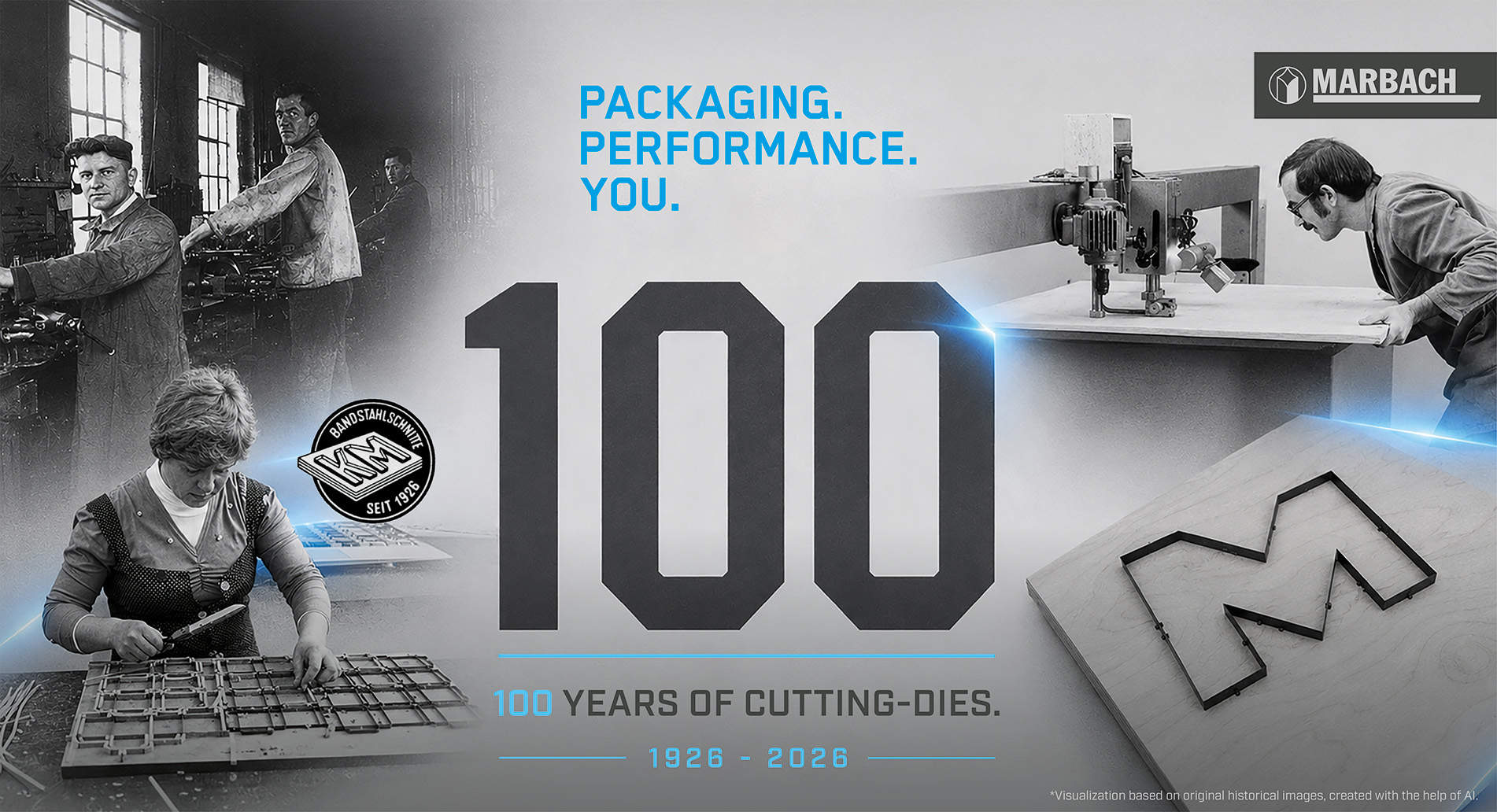
We are celebrating a special anniversary this year: the first cutting die was produced in 1926. Since then, the technology has undergone a fundamental transformation, from handcrafted, individual production to high-precision, industrial manufacturing processes. Marbach has actively shaped this development from the very beginning.
The entry into die-cutting die production in 1926 marked a decisive turning point in Marbach’s corporate history. At that time, the focus was still on the production of manual top knives for the regional leather industry. Heilbronn was considered a major leather hub back then and the shoe industry was consequently the most important sales market. However, with the economic challenges of the world economic crisis, orders from this sector declined significantly. As luck would have it, a new opportunity arose precisely during this phase: An acquaintance of Karl Marbach Senior, the owner of the advertising materials factory Willi Nupnau, was looking for a regional supplier of steel rule dies, as his previous partner in Berlin was too far away. Nupnau approached Marbach with a sample die and asked whether such production would be possible. For Karl Marbach Sr. this posed no difficutly. Nupnau used steel rule dies to cut out colored letters from paper, paperboard, and cardboard for storefront decorations, amongst other things.
In 1926, Marbach began manufacturing steel rule dies. The cutting rules were produced using simple means, such as sharpened gramophone springs. The needs of this first customer marked the beginning of die-cutting tool manufacturing at Marbach and paved the way into the paper processing and later packaging industries.
After World War II, production in Heilbronn was rebuilt under difficult conditions. With growing demand, the packaging industry in particular developed into a key market. At the same time, the requirements for tool precision rose continuously. Until well into the 1960s, cutting-dies were manufactured entirely by hand. The contours were drawn by hand on plywood boards and then the channel for the cutting rules was cut out using a decoupage saw. This step was particularly labor-intensive: the saw blade had to be repositioned for each individual contour. The saw blade was inserted into a pre-drilled starting hole, the contour was sawed out and then the blade was removed and reinserted at the next point. This process was time-consuming and required great care. If a starting hole was not hit exactly, the saw blades often broke.
The tolerances of the individual steps added up, limiting the accuracy of the tools.
The packaging industry’s demands for precision in die-cutting grew increasingly stringent in the 1960s due to new packaging and erecting machines. These machines were faster but also more sensitive and therefore required greater precision in the packaging blanks being processed. The tools manufactured by hand could no longer meet these demands.
The answer to this development was the use of laser technology. In the early 1970s, Karl Marbach Junior invested in this then-new technology. In 1972, the first NC-controlled CO₂ laser cutting system for die production in Europe was installed in Heilbronn. Despite initial challenges, this investment marked a turning point: laser technology set new standards in the quality of die production. In the years that followed, it became the industry standard.
“What made this technology special was the ability to produce contours with unprecedented precision and speed. This was a completely new approach in diemaking,” explains Peter Marbach, Owner & Managing Director of Marbach.
In addition to utilizing new technologies, Marbach has been driving its own developments for decades, thereby shaping the market to this day. Early on, the rillma product established a precise counter plate, which continues to form an important foundation for efficient processes. With the mpower cutting rule technology, Marbach set a standard that still stands for long tool life and reduced make-ready times.
The marbastrip stripping technology also remains an integral part of modern production processes and has been consistently refined, including into the masterstrip|plate. The crease-plate-die offers high-precision solutions for demanding applications. Digital zone levelling with DZL|plate and DZL|foil significantly reduces set-up times, as zone levelling needs to be performed only once and then remains effective over an extended period and across multiple tools. With CONNECT|M, Marbach goes one step further, connecting the machine, die, and user for transparent, data-driven production. In addition, Marbach has developed numerous other innovations. Many of these in-house developments have established themselves in the market and are now an integral part of the die-cutting industry.
“Innovation has always been a central component of our corporate development. Our goal is to systematically advance technologies and thereby set sustainable standards. At Marbach, you don’t just buy tools, you always buy a piece of the future.” says Peter Marbach.
Even after 100 years, Marbach stands for continuity and progress in diemaking, with a clear focus on precision, efficiency, and technological advancement.
